Grading That Levels Sloped and Uneven Ground
Grading in Denver, NC for residential lots, building-pad prep, and sloped terrain that drains and builds correctly
The sloped lots and red clay terrain around Lake Norman present specific challenges that flat-ground grading work simply does not. Callaway Grading performs residential and commercial grading in Denver, NC, working with the natural contours of local properties to establish stable, functional grades for construction, drainage, and usable yard space. Whether a project involves a raw lot that needs rough grading before a foundation pour or a finished yard that has settled unevenly over time, the approach starts with understanding what the existing grade is doing and what it needs to do once work is complete.
Rough grading establishes the primary elevation and slope of a site—stripping the high points, moving material to the low areas, and shaping the land to a workable profile before any structure or drainage system goes in. Final grading follows construction activity, smoothing the disturbed area to finished elevations that direct surface water away from structures and set up proper turf or hardscape installation. Building-pad preparation is its own scope of work: it requires a level, compacted surface engineered to support a foundation load, which on Lake Norman's sloped parcels often means significant cut-and-fill sequencing before compaction testing can confirm the pad is ready.
Arrange a site visit to review your property's current grade and discuss what the project requires before any equipment is scheduled.
How Grading Addresses Slope, Drainage, and Buildable Area
On residential lots in the Denver area, the red clay subsoil that sits beneath the topsoil layer behaves differently from sandy or loam soils when it is cut, moved, and compacted. Clay holds its shape under load but resists drainage when it is disturbed and recompacted without proper grading technique—meaning a poorly graded yard can shed water in the wrong direction or hold it against a foundation for extended periods. Callaway Grading accounts for that material behavior during both rough and final grading passes, shaping the subgrade profile before any topsoil is redistributed so the finished surface drains predictably.
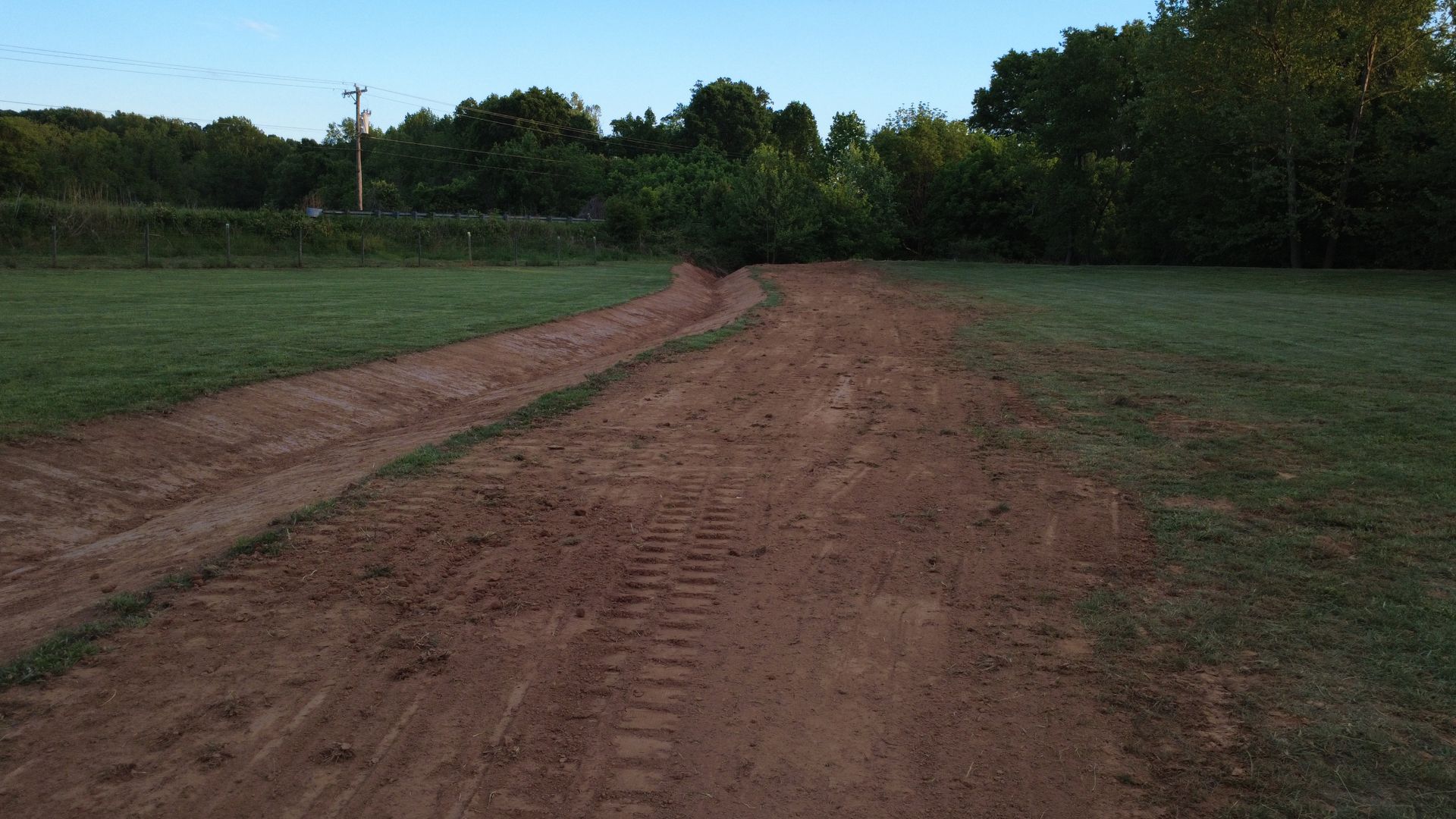
Once grading is complete, the changes are visible and functional: standing water that previously collected near a structure or in a low section of the yard no longer pools in those areas, the ground surface has a consistent slope away from the building, and a building pad sits level within the tolerance the foundation type requires. Yard leveling projects produce a noticeably flatter usable area, with transitions to existing slopes blended smoothly rather than left as abrupt grade breaks that are difficult to maintain or mow.
Commercial grading follows the same fundamental sequence—existing grade survey, cut-and-fill plan, rough grade, compaction, final grade—but typically operates under a site development plan with specified grades, detention requirements, and inspection hold points. The distinction between residential and commercial work matters because the tolerances, documentation, and sequencing requirements differ significantly, and a grading contractor needs to be set up for both rather than treating commercial work as an extension of residential practice.
What Property Owners Ask About the Work
The questions below address how grading is performed and what to expect on properties in the Denver area, particularly on sloped parcels and lots with red clay subsoil.
What is the difference between rough grading and final grading?
Rough grading moves the bulk of the soil to establish primary elevations and major slopes across the site, while final grading is a precision pass that brings the surface to finished elevations, smooths transitions, and sets the exact slopes needed for drainage and turf or hardscape installation—the two stages are separated by construction activity in most project sequences.
How does red clay subsoil affect grading work on Lake Norman lots?
Clay subsoil compacts well under controlled conditions but becomes difficult to work when it is overworked wet or when it is placed in thick lifts without proper compaction between passes, so grading on these lots requires attention to moisture content and lift thickness to avoid creating a subgrade that settles unevenly after the project is finished.
What does building-pad preparation actually involve beyond leveling the ground?
Pad prep requires not only achieving a level surface but compacting the fill material in controlled lifts—typically six to eight inches at a time—so the pad achieves a density that can support the foundation load without settling, and on sloped sites in Denver, NC, that often means cutting into the hillside on one side and placing engineered fill on the downhill side.
When should yard leveling be handled as a standalone project rather than combined with other work?
Yard leveling works best as a standalone project once all construction traffic on the property is finished, since equipment access and material staging during construction will re-disturb a graded surface and require a second final-grade pass anyway.
How do you tell whether a finished grade is actually directing water away from the structure correctly?
A properly graded surface maintains a minimum fall of six inches over the first ten feet away from a foundation, which is visible as a consistent outward slope when you sight across the yard from the building—flat or reverse-sloping areas near the foundation are the observable sign that regrading is needed.
Callaway Grading handles residential and commercial grading across Denver, NC, covering rough grade, final grade, building-pad prep, and yard leveling on the sloped and clay-heavy lots that define this area. Connect with Callaway Grading to schedule a property review and confirm what your site requires before work begins.